

Does a two-way radio need an Anatel license? Understand the cases
Does every two-way radio need a license? There is no single answer by brand or appearance. The first step is to separate three things that are often incorrectly called “radio license”: equipment homologation, authorization to use radio frequency and station licensing. The rule depends on the type of emission and how the network will be operated.
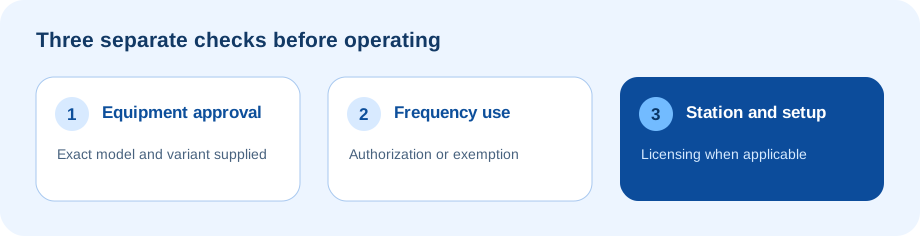
Homologation, frequency and station: three different checks
Check whether the equipment variant is homologated for commercialization and use in Brazil. Number and manufacturer can be consulted in Anatel’s public database.
A professional network outside restricted radiation conditions may require authorization to use specific frequencies. One does not choose a free channel “by eye”.
Depending on the service and station classification, there may be registration and operating license. License exemption does not automatically equate to exemption from other obligations.
A Anatel explains how to check homologation by the number on the seal or by manufacturer. Check the exact model and variant, including when the equipment is rented. A similar trade name does not prove that all versions have the same regulatory status.
Which general use radio frequencies can waive individual authorization?
Anatel does not “homologate a frequency” for any radio. It homologates the equipment and establishes technical conditions for bands and applications. For the General Use Radiocommunication Equipment, item 15 of Anatel Act No. 14.448/2017 presents 26 reference channels within 462.53-462.74 MHz and 467.53-467.74 MHz. The table below reproduces the centers of these channels, in MHz, for technical reference; the act also allows interstitial channels under specific conditions.
| Channel 01-13 | Frequency (MHz) | Channel 14-26 | Frequency (MHz) |
|---|---|---|---|
| 01 | 462,5625 | 14 | 467,5625 |
| 02 | 462,5750 | 15 | 467,5750 |
| 03 | 462,5875 | 16 | 467,5875 |
| 04 | 462,6000 | 17 | 467,6000 |
| 05 | 462,6125 | 18 | 467,6125 |
| 06 | 462,6250 | 19 | 467,6250 |
| 07 | 462,6375 | 20 | 467,6375 |
| 08 | 462,6500 | 21 | 467,6500 |
| 09 | 462,6625 | 22 | 467,6625 |
| 10 | 462,6750 | 23 | 467,6750 |
| 11 | 462,6875 | 24 | 467,6875 |
| 12 | 462,7000 | 25 | 467,7000 |
| 13 | 462,7125 | 26 | 467,7125 |
“Exempt” has conditions: the portable equipment must be certified/homologated for this classification and operate within the approved characteristics. The same act limits the effective radiated power to 500 mW and the occupied channel bandwidth to 12.5 kHz. It is not enough to program one of these frequencies into a higher-power professional HT to make it exempt. Changing power, antenna, configuration or purpose may change the classification.
When the network uses exclusively restricted radiation equipment in compliance, the Anatel informs of the exemption from individual authorization for radiofrequency use and from operating license of the corresponding transmitting stations. This does not exempt the product from homologation nor from other applicable duties. There is also no protection against interference from other stations: for a critical event, suitability needs to be tested, not presumed because the channel is in the table.
Which situation requires authorization and which can be exempt?
| Situation | What to check | Common mistake |
|---|---|---|
| Professional radio on own RF network | Homologation, service classification, authorization for frequency use and licensing or registration of stations as applicable. | Presuming that buying a homologated radio authorizes transmitting on any channel. |
| Equipment classified as restricted radiation | Homologation and full compliance with the limits and conditions of the classification. Anatel describes exemptions from frequency authorization and licensing for equipment that qualifies. | Calling any small portable ‘free use’ without checking the certificate and applicable rule. |
| PoC terminal via cellular/Wi-Fi network | Terminal homologation, coverage, contracted service/platform and third-party network conditions. | Confusing the use of the carrier’s network with a private RF network created by the customer. |
| Rental of professional radios | Who is responsible for frequency use, which operation and area are covered by the proposal and whether equipment/stations have been regularized. | Assuming that any supplier license covers every frequency, region and configuration. |
For a professional Private Limited Service (SLP) network, the Anatel Act No. 915/2024 provides channeling, among others, in parts of 148-174 MHz (VHF) and 450-470 MHz (UHF). These bands are examples of technical planning, not a list of channels released for any company: there are different sub-bands, channel widths, arrangements and allocations, in addition to authorization and licensing according to the project. Even two radios that display ‘UHF’ may be in incompatible bands or modes.
It is the technical and regulatory classification, not the logo, that determines the exemption. Anatel itself emphasizes that exemption from authorization does not eliminate other applicable duties. For a concrete project, confirm the documentation of the network and equipment before operation.
What changes when the company rents the radios?
In the rental of two-way radios from ABC Mais Telecom, the use of frequencies licensed with Anatel is already included in the contracted solution, according to the composition and conditions defined for that operation. The customer does not need to choose a frequency or write the programming of the devices on their own. Still, a responsible proposal identifies location, period, models, infrastructure and responsibilities; it does not promise that one authorization covers any imaginable scenario.
If the demand involves an event, temporary repeater, multiple addresses or integration with an existing network, regularization must be verified for the project. The Anatel guides event promoters to verify even possible temporary use of the spectrum.
What the radio brand alone does not tell
Motorola Solutions and Hytera offer families for professional networks and also technologies supported by data networks. Therefore, ‘Motorola doesn’t need’ or ‘Hytera needs’ are wrong phrases. See in ABC’s catalog the Motorola R2, Hytera HP506 and the Motorola TLK110 PoC as examples of different architectures, not as an automatic list of exemptions.
If your question started with distance, also read how to choose the technology and how rental works.
Frequently asked questions
Can a type-approved radio use any frequency?
No. Product type approval and the right to use a radio frequency are separate matters. For a professional network, check the applicable authorization and programming.
Does “license-free” mean no rules?
No. Restricted radiation equipment must comply with the technical requirements of its classification and the type-approval rules. There may be registration obligations depending on the service or installation.
Can I use 462.5625 MHz in any radio?
No. The channel appears in the table of Act No. 14.448 for general-use radiocommunication equipment, but the exemption depends on the equipment and operation being classified as restricted radiation, on type approval, and on technical limits. Programming the frequency into another HT does not grant exemption.
Does PoC/LTE require a customer-owned frequency?
The PoC terminal uses the data network provided by the carrier or Wi‑Fi, with a contracted platform; this is not a private RF authorization for the customer. The terminal remains subject to applicable type-approval rules.
In rental, who handles the frequency?
ABC’s rental solution includes the use of licensed frequencies for the contracted scope. Provide where, when, and how the radios will be used so the team can prepare the proposal correctly.
How do I verify a model?
Ask for the equipment’s type-approval number and check Anatel’s public database. Confirm the delivered variant; do not use only the family name as proof.
Official sources and review date
Regulation reviewed in October 2026; application to a specific case must be revalidated at contracting.
- Anatel: search for type-approved products.
- Anatel: cases and limits of authorization exemption.
- Anatel: radio frequency authorization and station licensing.
- Anatel: Act No. 14.448/2017, item 15 and Table XII (26 general-use channels, power and channel width).
- Anatel: Resolution No. 680/2017, restricted radiation, interference and certification.
- Anatel: Act No. 915/2024, SLP requirements and channeling.
Want a technically compliant proposal?
Describe the operation, not the frequency. The team evaluates equipment, coverage, and responsibilities for purchase or rental.
Talk to ABC Mais Telecom
Tell us briefly about your operation. Our team can help you assess equipment, rental or support in Brazil.