

Radio rental for 1 km or 5 km: how to test coverage
“I need to talk at 1 km” or “the team is at 5 km”: which radio to rent? Distance is the beginning of the assessment, not the answer. A 1 km route with basement and concrete can be more difficult than 5 km with open line of sight. To choose safely, define the points where the call needs to work and test the complete set: radio, antenna, authorized band and, if necessary, repeater or data network.
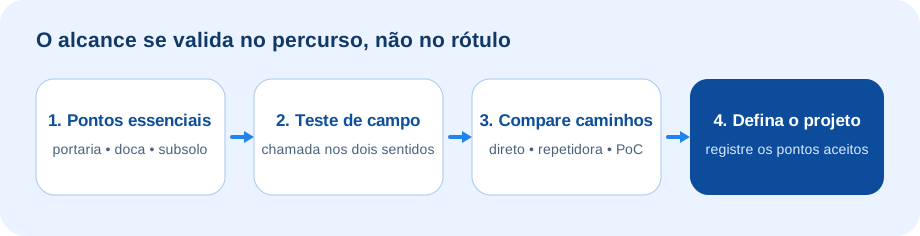
1 km and 5 km are not specifications of a radio
Manufacturers explain that obstacles and infrastructure change coverage. Antenna position, terrain, walls, metal structures, operating band and configuration also influence the result. Therefore, there is no “5 km” model that solves every operation. The useful question is: which people need to talk, at which points, under what conditions and with what quality?
| Informed scenario | What can change the result | First test | If it fails |
|---|---|---|---|
| Up to 1 km in open area | Uneven terrain, vehicles, temporary structures and user position. | Radio to radio at the extremes and at the points where the team actually moves. | Review antenna, position and coverage requirement before adding infrastructure. |
| Up to 1 km in building or warehouse | Basement, floors, concrete, metal and closed doors. | Front desk ↔ loading dock ↔ basement ↔ top floor, in both directions. | Evaluate repeater location and test again in the blind spots. |
| Up to 5 km with partial line of sight | Terrain, buildings, vegetation, antenna height and mobility. | Complete actual route, recording each failure and position. | Compare repeater, alternative positions or multi-site solution. |
| Teams in different cities or routes | Mobile and Wi-Fi coverage, platform, data and areas without network. | PoC/LTE on the actual stretches and plan for points without connectivity. | Combine technologies or change the operational flow; do not treat PoC as long-range RF radio. |
The table is a verification plan, not a test result from ABC Mais Telecom nor a promise for a specific address.
How to do a coverage test that helps decide
The installation guide for a Motorola repeater describes a field test with one person at the candidate repeater site and another walking the area with a radio. It is a simulation of coverage from that position, not automatic validation of the entire project. For rental or purchase, the test should reflect actual operation:
- Design the route. Mark mandatory points: control room, front desk, loading docks, garage, stairs, basement, far ends of the yard and already known shadow areas.
- Record the configuration. Note model and variant, antenna, authorized channel, operating mode and position of each participant. Without this, two rounds are not comparable.
- Make calls in both directions. Say a short phrase identifying the point, ask for a repeat and switch who transmits. “Heard one side” does not prove two-way conversation.
- Classify each point. Use criteria agreed before the test: intelligible without repetition, intelligible with repetition, or no communication. Record the observed reason, without turning impression into power measurement.
- Repeat when the environment changes. Closed gates, trucks at the dock, running machinery and moving teams can change the scenario. Test under relevant conditions, including critical shift or time.
- Compare alternatives on the same route. If there are failures, repeat with technically and legally feasible antenna or repeater position. For PoC, test the data network at the same points and the behavior when it drops.
When to test direct radio, repeater or PoC
It is the first test for teams in the same location. It has fewer components, but depends on the RF path between users.
Positioning and antenna system are part of the design. A poorly placed repeater does not eliminate every blind spot.
PoC connects distant teams where the network and platform are available. Without connectivity, this path needs contingency.
A repeater deserves study when there is repeated failure at essential points, floors, separate warehouses, or terrain. It is not mandatory because there is “5 km”, just as it is not dispensable because there is “only 1 km”. The Hytera single-repeater solution, for example, is described for local communication; multisite networks are another architecture. The choice depends on the survey, frequencies, and possible installation.
Products to start the comparison, without range promise
In the ABC catalog, the Motorola R2 and the Hytera HP506 are starting points for discussing professional radio; check the variant and band applicable to the project. For teams that move between locations with a data network, compare the Motorola TLK110 with WAVE PTX. None of these links replaces field evaluation.
See also ABC’s radio rental, repeater projects and our technology guide.
Frequently asked questions
Does a radio advertised for 5 km guarantee 5 km in my warehouse?
No. Nominal distance does not describe obstacles, antennas, frequency, or the quality required at each point. Test on the actual route.
If 1 km failed, is it enough to buy a more powerful radio?
Not necessarily. First find out where and why it fails. Antenna position, walls, basements, and repeater can be decisive; power and frequency must remain within authorized limits.
Are repeater and PoC the same thing?
No. The repeater retransmits radio communication on a planned RF network. PoC uses a data network and a PTT platform. Dependencies and contingencies are different.
How do I know if the test was sufficient?
If it covered all essential points, round trip, relevant conditions, and documented configuration, there is a basis for deciding. A test at a single point or time does not represent the entire operation.
Technical sources
Want to size the rental for your route?
Tell us which points need to communicate. The team can guide the composition of radios, repeater, or PoC for evaluation, without selling a distance in the dark.
Talk to ABC Mais Telecom
Tell us briefly about your operation. Our team can help you assess equipment, rental or support in Brazil.